
The History of Vicarius Filii Dei
For the past century, Catholicism has at times attempted to distance itself to its prior actions in establishing the pope as the Vicar of the Son of God in authoritative Canon Law, Apostolic Constitutions, Papal Letters, and other magisterial documents. However, in recent years, the evidence continues to mount from manuscripts at the Biblioteca Apostolica Vaticana which show this 666 title was formally used very widely.
Origins
The phrase Vicarius Filii Dei, meaning “Vicar of the Son of God,” first appears in the medieval document known as the Donation of Constantine, a forgery composed sometime around the eighth century. The document falsely presents the Roman emperor Constantine the Great as granting Pope Sylvester I and his successors extensive authority over Rome and the western territories of the Roman Empire. While the document was a forgery, Roman Catholicism defended it not only by citing it in numerous papal documents but also by placing the work De falso credita et ementita Constantini donatione declamatio, written by Laurentius Valla, on the Index Librorum Prohibitorum following the Council of Trent.
Discovery
Andreas Helwig (1572–1643) was a German classical scholar, linguist, and Protestant writer who became particularly known for his interpretation of the biblical number 666. In his work Antichristus Romanus, published in expanded form in 1612, Helwig examined various names and titles associated with the papacy and applied the ancient practice of assigning numerical values to letters. Ultimately he concluded that Vicarius Filii Dei fit all the criteria necessary for the 666 name of the apocalypse. His 1630 edition proposed the title on the very cover of the work. Adventists and many other protestants have joined Helwig in recognizing this is the 666 name mentioned in the apocalypse.
Authority
While some have questioned the authority of the title Vicarius Filii Dei, it is important to recognize the authority is not established by a triregnum but by law. It was the name which was "constituted" (to establish by force of law) in the Decretum Gratiani which became part one of the Corpus Iuris Canonici which was approved as perpetual and incorrupt by pope Gregory the 13th. The same canon law declared in distinctio 19 that the decretals therein contained were coenumerated with canonical scripture and in distinctio 20, anyone found without a copy and who did not abide by it was to be punished.
It was used by many popes including most recently in the 20th century and remains on the Vatican website to this day. Pope Paul the VI was the last to use it in his Rivi Muniensis, (1965) and in his Bafianae, (1968).
Evidence
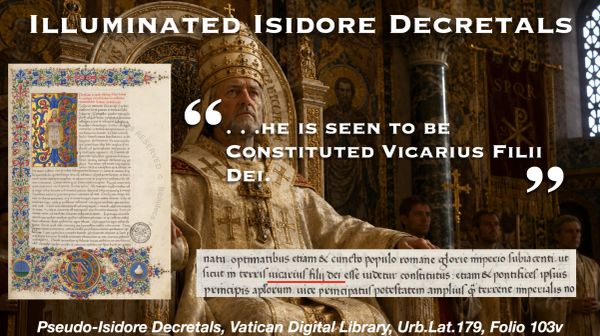
The Donation of Constantine's Blueprint
While the Donation itself was an earlier forgery. It became a sort of medieval blueprint of papal pretensions that were incorporated into the Pseudo-Isidorian decretals and eventually into the larger body of canon law. We see another example in a long line of falsehoods that Rome promoted in upholding her false claims to authority. Pictured left is an example of a Pseudo-Isidore Decretal in the Vatican Library, Manuscript:
Urb.Lat.179, Folio 103v
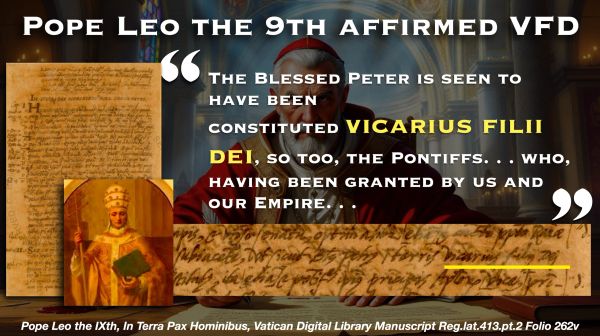
Papal Usage
In Terra Pax Hominibus was a papal letter of Pope Leo IX, addressed to Michael Cerularius, Patriarch of Constantinople, and Leo of Achrida. Dated September 2, 1053, it defended the primacy of the Roman See and rebuked the Eastern Church’s criticisms of Latin practices, including the use of unleavened bread in the Eucharist. It is particularly significant for its appeal to the Donation of Constantine and referring to the pope as Vicarius Filii Dei to support the pope’s claims to both spiritual and temporal authority. The letter formed part of the controversy that led to the East–West Schism of 1054.
Reg.lat.413.pt.2 Folio 262v
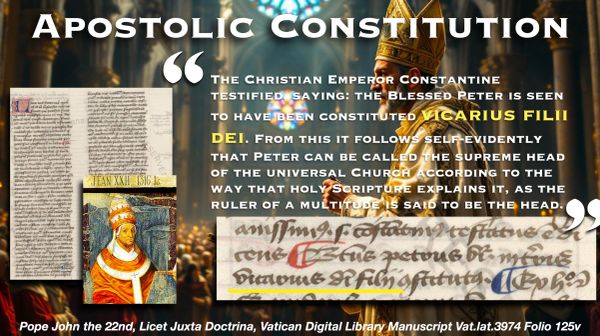
Papal Usage
Licet Juxta Doctrinam was a papal bull and Apostolic Constitution issued by Pope John XXII in 1327 during his conflict with Louis IV, Holy Roman Emperor, and the teachings of Marsilius of Padua. It defended the pope’s authority over the Church and rejected claims that the emperor could control ecclesiastical property, appoint or depose the pope, or exercise supreme authority over the clergy. It also upheld papal primacy and listed the pope as Vicarius Filii Dei.
Vat.lat.3974 Folio 125v

Papal Usage
Gratian’s Decretals or the Decretum Gratiani, was a twelfth-century compilation of canon law traditionally attributed to the Italian monk and jurist Gratian. It brought together earlier Church canons, papal letters, and other legal authorities, organizing them into a systematic treatment of ecclesiastical law.
Completed around 1140, it became the foundational textbook of medieval canon law and the starting point for the later development of the Corpus Juris Canonici. It is especially important for understanding how medieval canonists used earlier authorities to develop and justify claims about papal authority, Church governance, and the relationship between spiritual and temporal power. Pictured Right is an example of one of many copies available on the vatican website.
Pal.lat.623 Folio 79r
Comparison to Canonical Scripture
Distinction 19 of Gratian’s Decretum is significant because it places papal decretal letters on the same legal footing as the canonical scripture. Pope Nicholas I argues that decretals should be accepted even when they are not included in the canonical collections, comparing their authority to that of the Old and New Testaments, which are likewise received as authoritative even though they are not contained in the canons. The distinction thus illustrates how medieval canonists could co-enumerate papal decretals with Scripture as authoritative ecclesiastical writings. In those same decretals was the constituted name Vicarius Filii Dei
Vat.lat.1375 Folio 14R
Force of Law
Distinction 20 chapter 2 of Gratian’s Decretum which was included as part one of the Corpus Iuris Canonici contains the following statement demonstrating that those who did not follow and accept these decretals were worthy of reproof and chastisement.
Papal Approved Canon Law
Ultimately Gratians decretals were included in part 1 of the Corpus Iuris Canonici which also included the name Vicarius Filii Dei and which was approved by Gregory the 13th.
Papal Approved Canon Law
When the Corpus Iuris Canonici was published in 1582, it bore the approval of Pope Gregory the 13th and contained an introduction wherein the final copy of law was said to be free from all error so that it may be perpetually preserved and incorrupt. As already seen, it retained the title Vicarius Filii Dei.

A Catholic Protest?
Laurentius Valla’s critique of the Donation of Constantine exposed the original document as a forgery, challenging the claim that Constantine had granted the pope extensive temporal authority. His De falso credita et ementita Constantini donatione declamatio became a landmark in the historical criticism of papal claims.
Valla’s work, written around 1440, demonstrated through linguistic and historical analysis that the Donation could not have been written in Constantine’s time. His protest helped undermine one of the principal historical foundations of papal temporal power.
Catholic Rejection
Laurentius Valla’s De falso credita et ementita Constantini donatione was subsequently condemned in the Roman Catholic Index Librorum Prohibitorum. Its inclusion reflected Rome’s opposition to a work that directly exposed the Donation of Constantine as a forgery and challenged the historical basis for papal claims to temporal authority. Rome preferred to retain the and defend the forgery that spoke to papal authority including the name Vicarius Filii Dei.
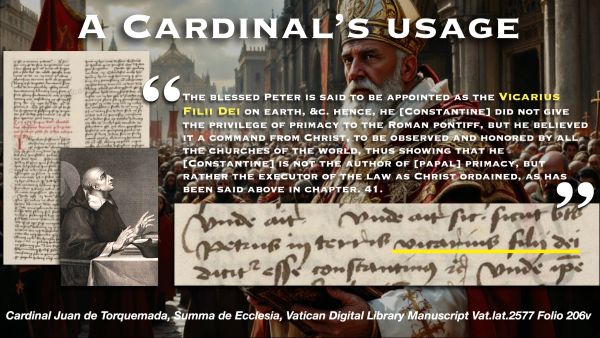
Broader Acceptance
Juan de Torquemada’s Summa de Ecclesia (c. 1448–1453) was one of the most influential medieval defenses of papal authority and included the title Vicarius Filii Dei. Written shortly before the Reformation, it presented a systematic theology of the Church, emphasizing the pope’s supreme jurisdiction and the necessity of papal authority for the unity and governance of Christendom.
Vat.lat.2577 Folio 206v
Broader Acceptance
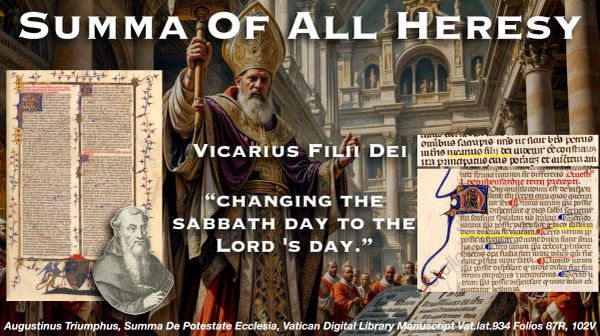
Augustinus Triumphus’s Summa de potestate ecclesiastica (c. 1320) was a major medieval treatise defending the supreme authority of the pope over the Church and Christian society. It argued that Christ entrusted universal jurisdiction to Peter and his successors, providing a powerful theological foundation for later papal claims of supremacy over both ecclesiastical and temporal affairs. In addition to defending the pope as Vicarius Filii Dei, it also speaks of his power to change the Sabbath from Saturday to Sunday.
Vat.lat.934 Folios 87R, 102V
Evidence Continued
Library of Congress Evidence
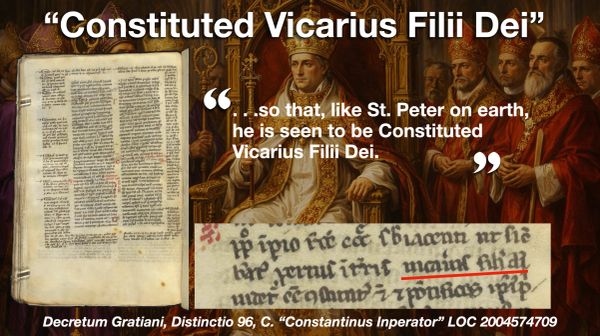
Here at Heritage and Hope, we've taken the time to actually track down some of the original 13th century copies of the primary source documents. To the left is pictured a 13th century document available in the library of congress containing the Decretum Gratiani specifically Distinction 96 containing the title.
What about the Tiara?
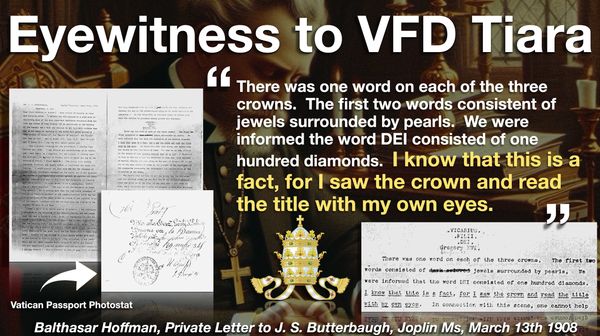
While evidence of a Tiara containing the title has long been debated it is important to remember that authority in any government is ultimately founded in law. Thus, a tiara containing the title is really secondary evidence to that which is already firmly grounded in canon law and public authoritative documents which are widely available. There has also been much time for Rome to react to protestant concerns and remove tiara's from public view. However, there have been multiple published accounts from witnesses who previously saw the tiara's with Vicarius Filii Dei on the front.
Another Witness
There have been multiple witnesses who wrote down their own testimony of what they saw inscribed upon the papal tiara. While images exist for some tiara's, not all have been photographed and Rome has by now been aware of the concern for a few hundred years with ample opportunity to conceal the evidence of what was loudly proclaimed during the height of her power during the 1260 year period.
A Tiara with Analogous Title
The Belgian Tiara, sometimes called the Ghent Tiara, was a papal tiara presented to Pope Pius IX in 1871 by the women of the royal court of King Leopold II of Belgium. It was designed by the prominent Belgian Catholic architect and artist Jean-Baptiste Bethune of Ghent and manufactured in Ghent. It contains the title Vicarius Christi which has long been recognized as analogous to Vicarius Filii Dei. What is interesting is Leviticus 24:18 uses the term "vicarium" in latin to refer to the substitute, while in the LXX, the substitute commented on later in the verse "life for life" is referred to with the word ἀντί. Therefore Vicarius Christi in Latin would mean ἀντίχριστος (Antichristos) in Greek.
Catholic Scholars
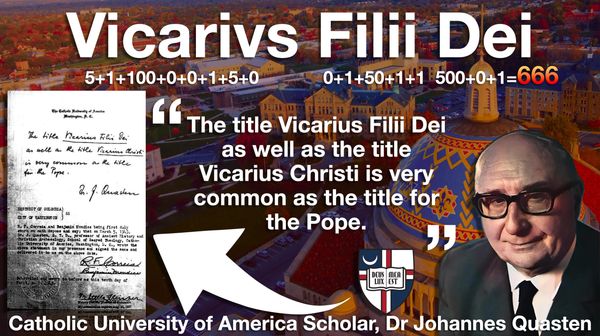
Johannes Quasten (1900–1987) was a prominent German Roman Catholic priest, theologian, and patristic scholar who became one of the leading twentieth-century authorities on the early Church Fathers. He taught for many years at the Catholic University of America, where he also served as dean of theology. He previously admitted in writing that the title Vicarius Filii Dei as well as the title Vicarius Christi are very common as the title for the pope.
Catholic Scholars
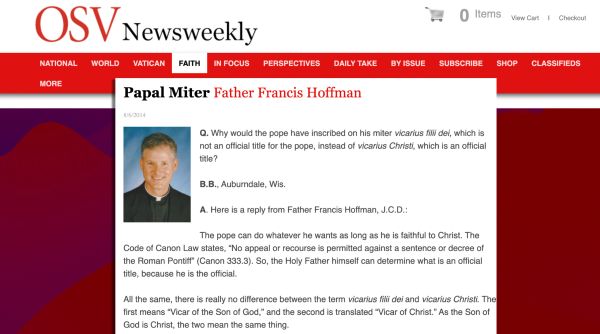
Over the years, multiple catholic publications such as Our Sunday Visitor have commented on the titles Vicarius Christi and Vicarius Filii Dei as being analogous but also being upon the tiara as well. However, we would remind the reader that the title's authority is best founded upon authoritative canon law and papal letters from the magisterial authority in the catholic church: The Pope himself.