
Jefferson's Wall
Over the recent years, many have attempted to suggest that Jefferson's wall wasn't really that significant and perhaps did not really represent the foundation of American religious liberty and the first amendment. Was this really the case?
Origins
The principle of a “wall of separation” between church and state did not originate with Thomas Jefferson. The idea had much earlier roots in Christian and Protestant thought, particularly among Baptists and other advocates of religious liberty who argued that civil government should not control religious belief or worship. Jefferson’s famous 1802 reference to a “wall of separation between Church & State” expressed and popularized an established principle rather than creating it from nothing.
Authority
Biblically, civil authority has a legitimate but limited sphere of jurisdiction. In Matthew 22:21, Jesus distinguished between what belongs to Caesar and what belongs to God: “Render therefore unto Caesar the things which are Caesar’s; and unto God the things that are God’s.” Likewise, Romans 13 emphasizes obedience to civil government in matters of civil order, justice, and public conduct—but notably does not delegate to caesar enforcing obedience concerning the first four commandments, which concern humanity’s direct relationship with God. From a Protestant perspective, this distinction establishes that the state has authority over civil matters, while worship, conscience, and allegiance to God remain outside the state’s jurisdiction.
Contrast with Catholicism
From a historic Protestant perspective, separation of church and state protects religious liberty by limiting civil government to its proper sphere and preventing the state from enforcing religious belief or worship. This contrasts with the traditional Catholic conception of church–state cooperation, in which civil government was expected to recognize and support the true religion and protect the Church’s spiritual authority. Protestants therefore viewed the union of ecclesiastical and civil power as a threat to freedom of conscience and a departure from Christ’s distinction between “the things which are Caesar’s” and “the things that are God’s” (Matthew 22:21).
History of AMerican Liberty
Escaping Catholicism
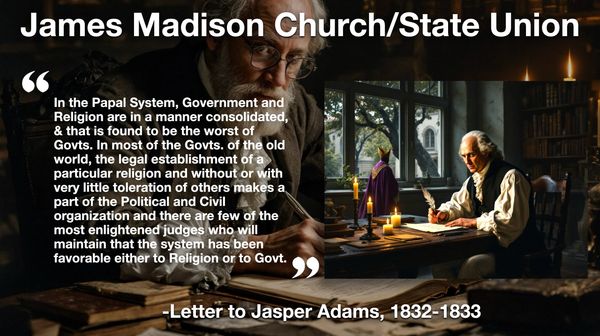
James Madison strongly rejected the idea that civil government should establish, enforce, or financially support religion. In his writings on religious liberty, Madison argued that religion must be left to the conscience of individuals rather than placed under the authority of the state. From a Protestant perspective, his position stood firmly against the historic European model of church–state union, insisting that civil power should neither govern the Church nor use its authority to enforce religious observance.
Thomas Jefferson
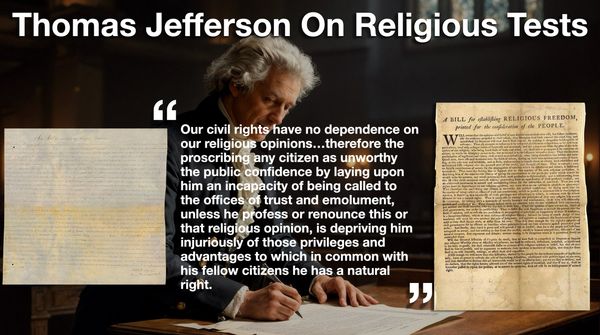
Thomas Jefferson likewise rejected the union of church and state, arguing that civil government should have no authority over religious belief or worship. In his 1802 letter to the Danbury Baptists, Jefferson described the First Amendment as building a “wall of separation between Church & State,” protecting the free exercise of religion while preventing government establishment or coercion. From a Protestant perspective, Jefferson’s position represented a decisive rejection of the European model in which civil power was used to uphold ecclesiastical authority. His statements were echoed elsewhere as well in other documents.
Thomas Jefferson
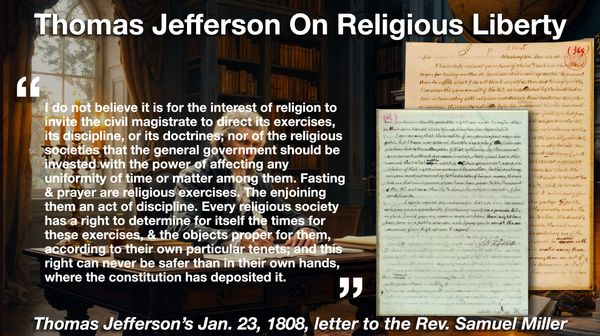
In his 1808 letter to Samuel Miller, Thomas Jefferson argued that the federal government should remain completely separate from religious instruction and authority. Jefferson’s letter reinforces the principle that civil authority must not assume jurisdiction over matters belonging to God and conscience, rejecting the European model of an established church supported or enforced by the state.
George Washington
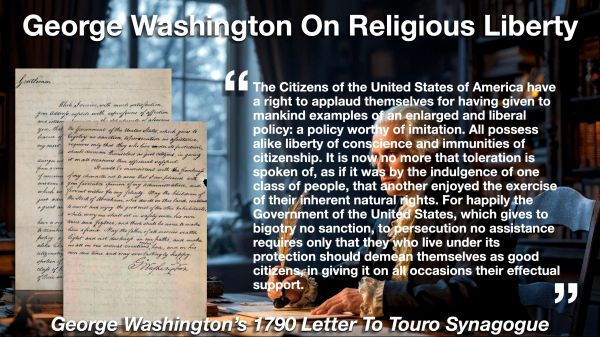
George Washington expressed a similar commitment to religious liberty in his 1790 letter to the Hebrew Congregation of Newport, Rhode Island, led by Moses Seixas (sometimes referenced in discussions of religious liberty alongside Washington’s correspondence with Touro). Washington assured the congregation that the new American government would give “bigotry no sanction, persecution no assistance,” emphasizing that religious liberty was a fundamental principle of the new republic. From a Protestant perspective, this represented a clear rejection of the coercive European model in which civil government enforced religious conformity.
James Madison
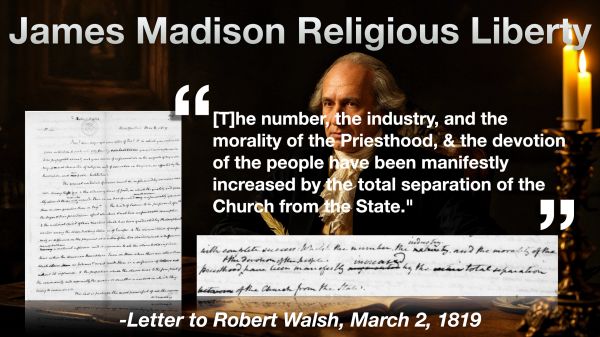
James Madison expressed the same principle in his 1819 letter to Robert Walsh, where he reflected on the benefit to the devotion of people by total separation of the church from the state. Madison emphasized that separating civil authority from religious authority had helped protect both religious liberty and civil government.

The "Wall" Before Jefferson
Roger Williams articulated the principle of a “wall of separation” between church and state well before Thomas Jefferson. In his writings in the seventeenth century, Williams argued for a firm separation between civil government and religious authority, warning that mixing the two would corrupt both the church and the state. His advocacy of religious liberty and freedom of conscience helped establish an American tradition that later found more famous expression in Jefferson’s 1802 description of a “wall of separation.”
The "Wall" Before Jefferson
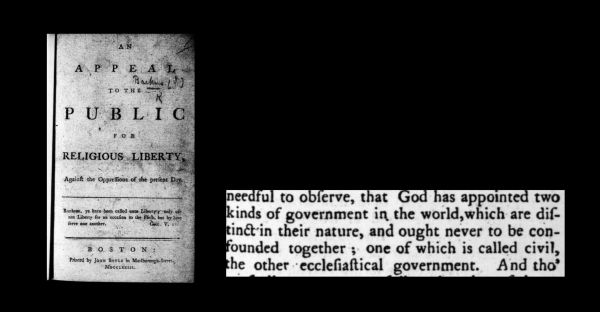
Isaac Backus, a prominent Baptist and Protestant advocate of religious liberty, strongly defended the separation of church and state in eighteenth-century America. Backus argued that civil government had no authority to compel religious belief or support a particular church, insisting that faith must be a matter of conscience. His writings demonstrate that the principle later expressed by Jefferson as a “wall of separation” was deeply rooted in Protestant dissenting thought, particularly among Baptists who had experienced the dangers of established religion firsthand.
Religious Liberty in the Early Church
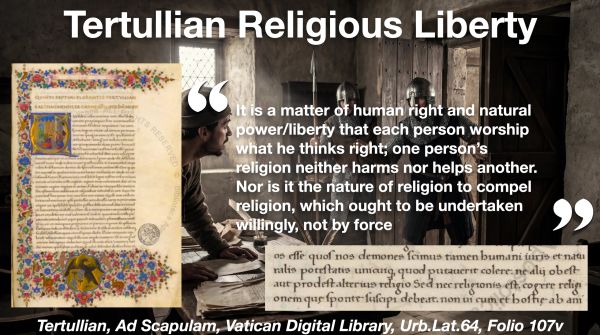
Tertullian, writing in the early third century, strongly defended freedom of conscience in matters of religion. He argued that religious belief must be voluntary and that God does not desire worship compelled by force. His defense of religious liberty reflects an early Christian principle that faith cannot be legitimately imposed by civil authority, a concept that later became particularly important within Protestant arguments for separation of church and state.
Religious Liberty in the Early Church
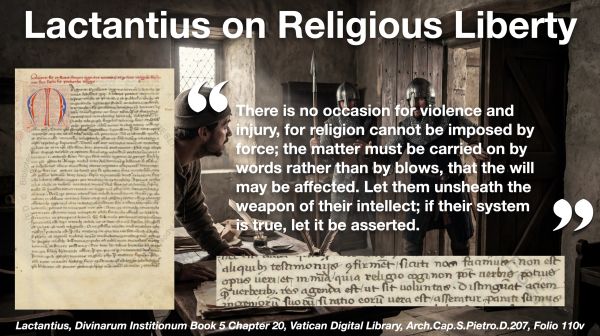
Lactantius, the early fourth-century Christian apologist, strongly defended religious liberty and freedom of conscience. He argued that religion cannot be imposed by force, since genuine worship must be offered voluntarily rather than through coercion. His writings provide early Christian support for the principle that civil power should not compel religious belief or worship, a concept later emphasized by Protestant defenders of religious liberty.
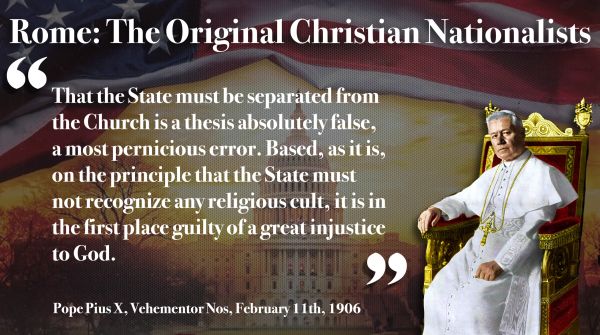
Rome Rejects Religious Liberty
Roman Catholicism has traditionally rejected the idea that religion should be entirely separated from civil government, instead teaching that civil society should recognize and protect the true religion. This framework supports a form of Christian political establishment in which government cooperates with and gives public recognition to the Church. Protestants have therefore contrasted the Catholic model of church–state union with religious liberty, which protects freedom of conscience and prevents civil power from enforcing religious observance. Rome upholds Christian Nationalist principles.