
Righteousness By Faith
The 1888 message associated with A. T. Jones and E. J. Waggoner can best be summarized as a call to recover the faith of Caleb and Joshua: trusting God’s promises so fully that His people are prepared to enter the promised inheritance rather than turning back in unbelief.
Their emphasis on Christ our righteousness joined justification with the living work of Christ in the believer—His righteousness imputed to the believer by faith and imparted through the indwelling Christ, producing genuine victory over sin.
Jones and Waggoner’s message was not merely that Christ forgives sin, but that Christ has power to save completely. The final generation would demonstrate the reality of this gospel fully by overcoming every known sin through faith in Christ, not by unaided human effort or legalism, but through the divine life and righteousness of Christ dwelling within.
Like Caleb and Joshua, they would believe that God’s promise is sufficient and that, through His power, His people can possess the inheritance He has promised.
Origins
In the decades leading up to 1888, Seventh-day Adventists debated intensely over the meaning of Paul’s law-and-covenant language in Galatians. The central question was whether the “law” Paul described as being “added because of transgressions” and serving as a “schoolmaster” referred primarily to the ceremonial law or to the moral law, including the Ten Commandments. Adventist pioneers generally defended the moral law as perpetually binding, but disagreement arose over how Galatians related to the covenants and the role of the law in salvation.
This controversy became especially important in the 1888 Minneapolis discussions, when E. J. Waggoner argued that Galatians could not simply be explained away as referring only to the ceremonial law. His presentation connected the law, the Abrahamic covenant, and justification by faith in Christ, emphasizing that the law exposes sin and leads the sinner to Christ rather than functioning as a means of righteousness. A. T. Jones likewise emphasized the relationship between the law and the gospel and opposed using the law in a manner that displaced Christ. From an RBF perspective, this controversy is significant because it placed Christ and His righteousness at the center of the law-and-covenant question, rather than treating obedience as an alternative to faith.
Reaction in 1888
The 1888 message of Christ our righteousness, presented by E. J. Waggoner and A. T. Jones, was strongly affirmed by Ellen G. White, who repeatedly testified that God had sent a precious message of justification by faith through these messengers. She later referred to the message and its rejection or resistance in Minneapolis and afterward on numerous occasions—more than 300 references according to some Adventist compilations. This is significant because the message was not merely a doctrinal correction concerning justification; it called the church to receive Christ’s righteousness by faith and experience His transforming power in the life. Although the message was resisted by significant elements of the church leadership in 1888, Ellen White continued to urge its acceptance as essential to the proclamation of the gospel and the preparation of God’s people.
Current Discussion
The Righteousness by Faith (RBF) message continues to uplift Christ as the complete solution to the sin problem. It calls God’s people away from self-reliance and legalism and back to the living Christ, whose righteousness is both imputed for our justification and imparted through His indwelling power for victorious Christian living. The final purpose of this message is not merely forgiveness, but a people who, through faith in Christ, overcome sin and demonstrate that God’s grace is sufficient to reproduce His character in fallen humanity. In the language of the great controversy, all heaven is waiting for God’s people to fully trust Christ and allow His righteousness to be manifested in their lives, thereby vindicating the justice and righteousness of God’s law before the universe.
"All heaven is waiting to hear us vindicate God’s law, declaring it to be holy, just, and good. RH April 16, 1901, par. 16"
The final victory belongs entirely to Christ, but He accomplishes it through a people who surrender completely to His indwelling presence.
Historical Quotations

Christology
Christ took upon Himself our fallen human nature, yet lived completely without committing sin. He entered the very conditions of fallen humanity in order to demonstrate that, through complete dependence upon the Father and the indwelling power of the Holy Spirit, humanity can live in obedience to God. Christ’s life is therefore not only the ground of our justification but also the supreme revelation of what God’s grace can accomplish in a surrendered human life—showing that victory over sin is possible through Christ dwelling within. Here at Heritage and Hope, we uphold the Baker Letter, but also know that the victory Christ obtained can be our own by Faith.

Overcoming
The gospel calls us not merely to receive forgiveness for sin, but to experience complete victory over sin through Christ. By faith, the believer may continually surrender to Christ and receive His righteousness, allowing His power to overcome every known sin and bring the life into harmony with God’s will. This victory is not achieved through human strength or self-righteousness, but through Christ dwelling within, whose grace is sufficient to keep the believer from falling. It is also something the believer will never pridefully declare of himself.
Close of Probation
The saints must be prepared for the time of trouble and the seven last plagues, when Christ’s mediatorial ministry has ended (Revelation 15:8), (Isaiah 59:16) and there is no longer an intercessor pleading His blood for confessed sin. They must therefore have already received the fullness of Christ’s righteousness and, through His indwelling power, have gained complete victory over sin. During this final period, they will stand by faith in God’s promises, trusting Christ’s righteousness while committing no known sin—not through their own strength, but because Christ has fully accomplished His work in them
Alonzo Jones and 1888
Alonzo T. Jones (1850–1923) was a prominent Seventh-day Adventist minister, editor, author, and one of the principal figures associated with the 1888 Minneapolis General Conference, alongside E. J. Waggoner. A former soldier who became an Adventist preacher, Jones became known for his powerful preaching on justification by faith, Christ and His righteousness, Christian liberty, and the law of God

Papal Distortions to RBF
From a Great Controversy perspective, the papal system is portrayed as embodying two opposite but related errors concerning salvation: salvation in sin and salvation by human merit. The first minimizes the transforming power of grace by allowing the sinner to remain in sin while claiming Christ’s forgiveness; the second places confidence in human works, penance, or accumulated merit rather than entirely in Christ. The biblical gospel rejects both extremes: Christ saves us from sin, not in sin, and righteousness is received by faith rather than earned by human merit. Thus, the true answer is Christ’s righteousness—received by faith and manifested through a transformed life.
Downfall of Jones and Waggoner
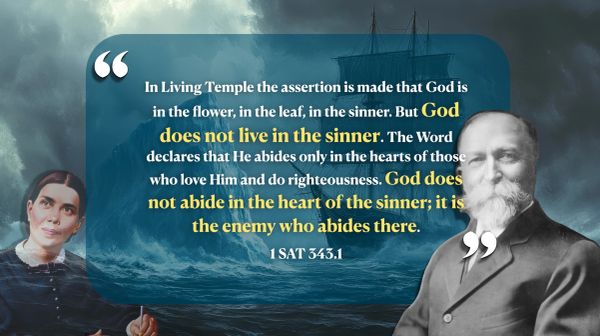
J. H. Kellogg’s later pantheistic teachings contributed to the theological crisis that helped undermine the faith of A. T. Jones and E. J. Waggoner. Kellogg’s teaching about God’s presence in nature and in humanity blurred the distinction between Christ dwelling in the believer and the idea that God is inherently present within everyone and everything. This was fundamentally different from the 1888 emphasis on Christ’s righteousness received by faith and His personal indwelling power to overcome sin. In this interpretation, Kellogg’s pantheism ultimately distorted the doctrine of sanctification: rather than emphasizing conscious faith, surrender, and victory through a personal Christ, it could reduce the indwelling Christ to an impersonal divine presence disconnected from victory.


