
Dominum Deum Nostrum Papam
In The Great Controversy page 50, the statement is made of the pope that: "He styles himself "Lord God the Pope," assumes infallibility, and demands that all men pay him homage." Over the years, some have doubted if this statement was really original, authoritative, and verifiable. Over 400 years ago, one jesuit author claimed that it did not exist in the original manuscripts at the Vatican. After 400 years, Heritage and Hope ministries had the opportunity to solve this and locate the original manuscript and verify.
Origins
The origins of the phrase "Dominum Deum Nostrum Papam" are found in the Extravagantes of Pope John XXII which were a collection of twenty papal constitutions issued during his pontificate (1316–1334) that circulated outside the established collections of the Corpus Juris Canonici. Because these decretals were “wandering outside” (extra vagantes) the earlier canonical collections, they came to be known as the Extravagantes. In 1325, the canonist Zenzelinus de Cassanis (also called Zenzelino de’ Cassani) gathered the twenty constitutions into a systematic collection and supplied them with a detailed gloss, or legal commentary. It was in his commentary on chapter 47 Quia quorundam mentes where we find the statement "Dominum Deum Nostrum Papam".
Authority
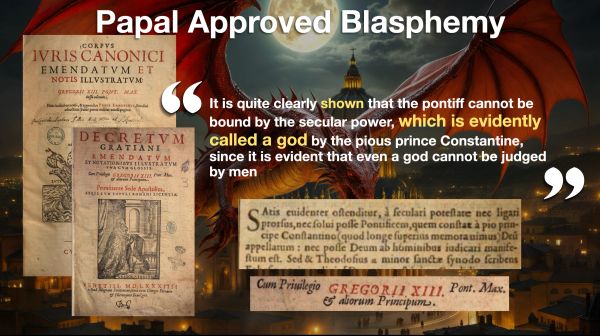
The Extravagantes and their accompanying gloss were authoritative because they formed part of the developing body of papal canon law used by medieval canonists and ecclesiastical courts. The Extravagantes collected papal decretals that circulated outside the earlier canonical collections, while the gloss provided the interpretive commentary of recognized canonists, explaining how the decretals were to be understood and applied. Together, the decretals and their glosses became standard materials in the teaching and interpretation of canon law and therefore carried substantial weight in determining accepted ecclesiastical doctrine and legal practice. The later Correctores approved the Roman edition of the Extravagantes in 1582 and 1584, and the edition retained the reading “Dominum Deum nostrum Papam” (“our Lord God the Pope”), preserving the controversial wording found in the original 14th century Vatican source in the officially corrected roman text of the 16th century. In addition, the gloss itself was consistent with the main body of canon law (Distinctio 96, Chapter "Satis Evideter") which also shewed the pope could justly be called god.
Catholic Response
Over the years, some catholic blogs and even a jesuit have outright claimed the original vat.lat.1397 did not have the gloss, suggesting perhaps it was only a later scribal interpolation. While several editions published over the years did omit the word deum from the text, the original vat.lat.1397 did in fact retain the gloss as well as the roman approved and corrected edition. This was further commented upon by António Pereira de Figueiredo (1725–1797), who was a Portuguese Catholic theologian, priest, and biblical scholar who became an important Jansenist-leaning critic of ultramontane papal authority. He noted that the pope had never denied usage of the title. While some Catholic blogs have questioned his existence, his work "Tentative Theologica" is publicly available online.
Evidence

The Original 14th Century Source
While some Catholic Blogs have claimed the statement does not exist in the original, it can indeed be found there to this day, folio 166v.

Catholic Denials
For hundreds of years, catholic authors from the days of the jesuit author Andreas Eudaemon-Joannes (1566–1625) have claimed the original did not have the word "Deum" (god) in it. In the 19th century, it was noted that protestants would have to take this assertion on trust for undoubtedly the originals were kept in the Vatican from the "prying eyes" of Protestants. More recent but continued denials have been found on some catholic blogs.
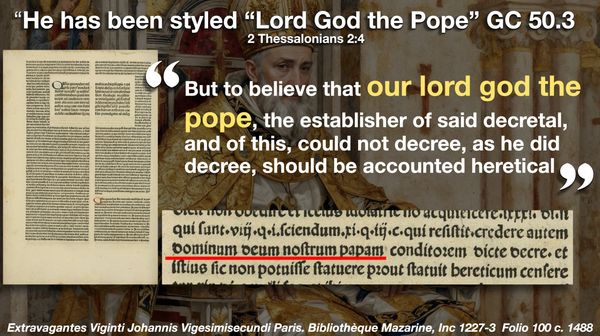
15th Century Usage
Up until recently, even within Adventism, some have questioned the strength of the manuscript evidence for the phrase. However, more recent digitization efforts have revealed that even prior to the 16th century, this phrase was being used in copies of Extravagantes. Here is another example.
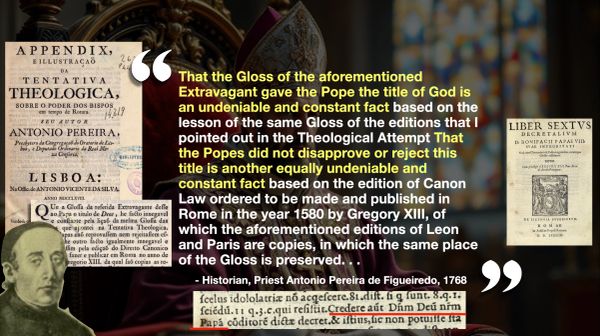
Catholic Concerns
Even within catholicism, there were those opposed to some of the ultramontane statements and usurpations. Here we read from a catholic author that there was no distancing from the title. There is good reason for this, because it agreed with the main body of canon law.
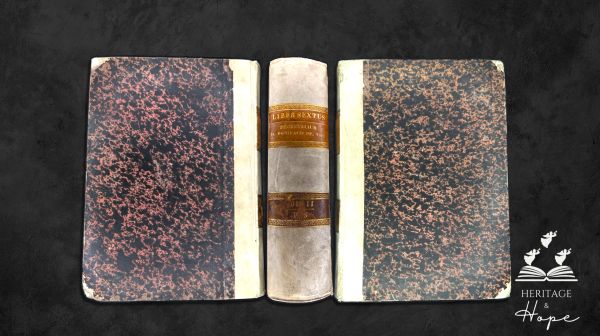
Heritage and Hope Evidence
Here at Heritage and Hope, we collected a copy of the 1595 Extravagantes containing the title to demonstrate the physical proof of the concern.
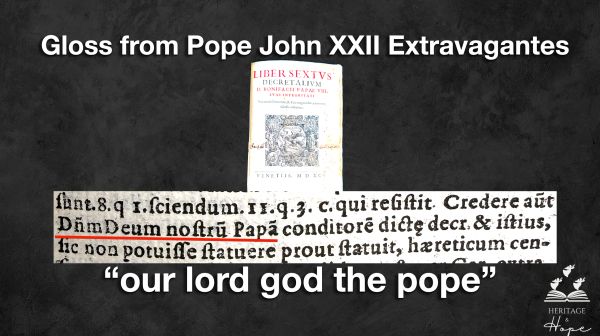
Heritage and Hope Evidence
To the right is pictured the statement in our work demonstrating this was really a statement used. Our catholic friends may be quick to point out that it was only a gloss, but its important to recognize the connection and consistency to the main body of canon law.
Decisive Authority
Our catholic friends may be quick to dismiss the statement as only a gloss and claim it as non-authoritative. However, it is important to note that the main body of canon law Distinctio 96 Chapter "Satis Evideter" already upheld that the pope could justly be called god. This was also upheld further in detail in C. XI, q. 1, c. 41. This was further approved and signed off by Pope Gregory the 13th himself in the Corpus Iuris Canonici approved and corrected in 1582 which was said to be free from all error. Thus the gloss was consistent with the main body and with good reason, Rome never formally rejected it.
How Else Was the Pope Called God?
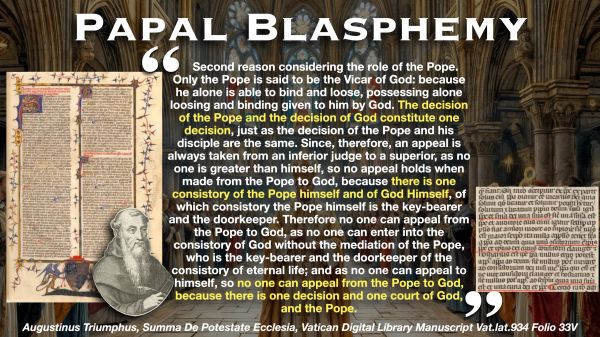
Augustinus Triumphus’s Summa de Potestate Ecclesiastica (c. 1320) was a major medieval treatise defending the supreme authority of the pope and the Roman Church. Written by the Augustinian theologian Augustinus Triumphus (1243–1328), it argues that Christ entrusted the Church, and especially the papacy, with supreme spiritual authority. Triumphus maintained that the pope possessed universal jurisdiction over Christians and that papal authority extended even to matters involving temporal rulers when spiritual interests were concerned. Here we see how the pope was compared to God.
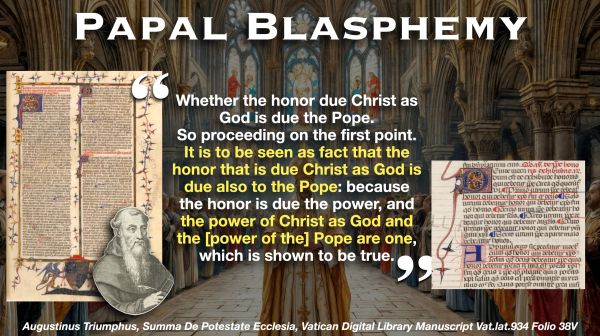
How Else Was the Pope Called God?
Augustinus Triumphus’s Summa de Potestate Ecclesiastica (c. 1320) upheld in multiple ways how the pope was equal with god. It demonstrates well the high water mark of papal pretensions during the middle ages.
How Else Was the Pope Called God?
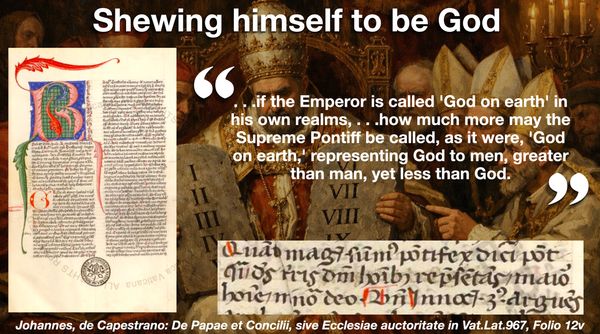
Johannes of Capestrano’s De Papae et Concilii, sive Ecclesiae auctoritate (“On the Authority of the Pope and the Council, or of the Church”) was a fifteenth-century treatise defending papal supremacy over general councils, arguing that the pope possessed supreme authority in the Church and that a council could not exercise authority over the pope. Capestrano composed it around 1440, during the controversy between papalists and conciliarists.
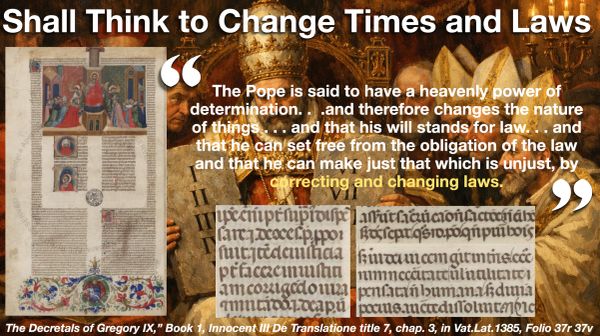
What did papal authority extend to?
This is Innocent III’s decretal on the authority of the Roman pontiff, incorporated into Gregory IX’s Decretals. It asserts that the power to transfer bishops belongs specially to the Roman pontiff and his successors, emphasizing the pope’s unique authority in the Church. The accompanying gloss became especially significant in later discussions of papal authority for it upheld papal power to change and correct laws. Something significant in light of Daniel 7:25
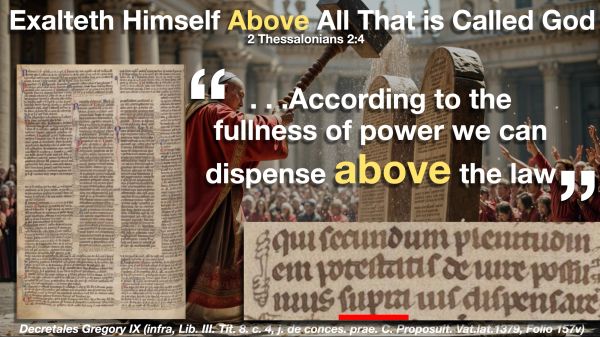
What did papal authority extend to?
Here we see that power extended to dispensing above the law. Later jurists like Lucius Ferraris would write that the pope has so much power that he can modify, declare, or interpret even divine law. The latin word chosen here "supra" is actually the same one in the latin vulgate for 2 Thessalonians 2:4 when the man of sin exalts himself above all that is called god.
"Correcting and changing laws"
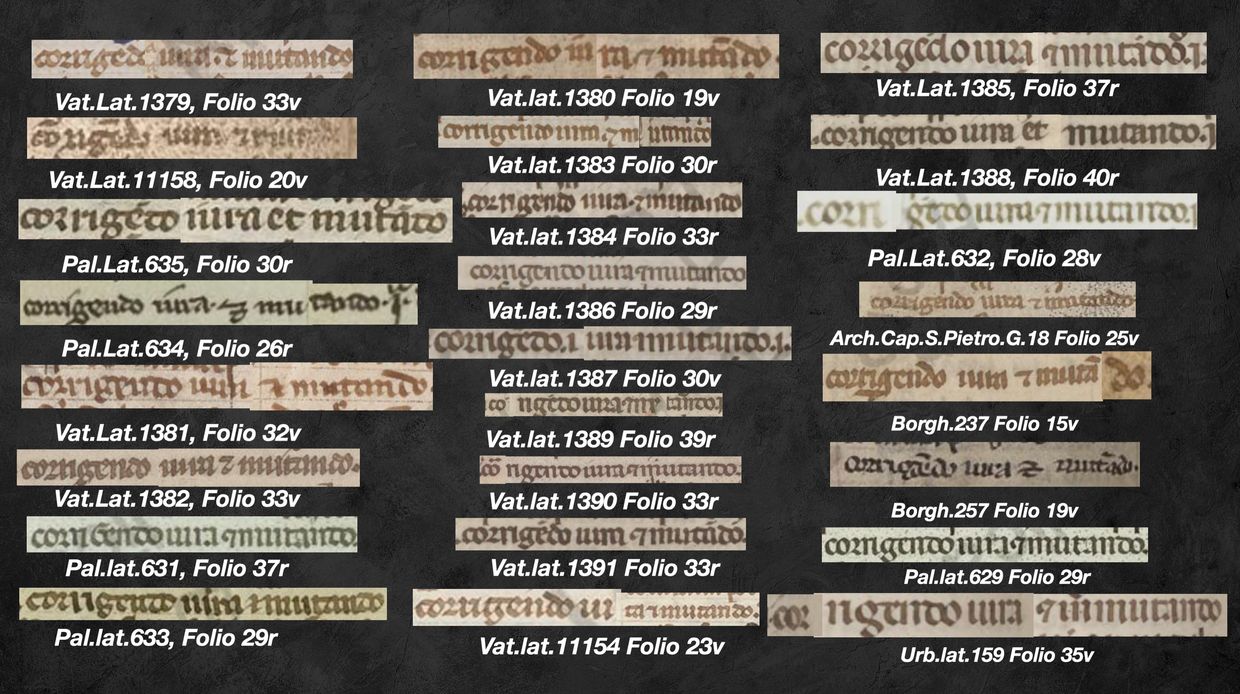
The Decretals of Gregory IX, Book 1, Innocent III De Translatione title 7, chap. 3
Ultimately roman power extended to the position of God by placing itself in a position to change the law of God. This has occurred with the attempted and unlawful change of the Sabbath from Saturday to Sunday. Above are manuscripts and pagination for the explanation of papal authority on the Vatican Website.