
History of the Waldenses
The history of the Waldenses raises an important question: Were they merely a movement that began in the twelfth century, or did they represent a much older and purer strain of Christian faith and practice? Traditional accounts often trace their organized history to Peter Waldo and the preaching of his followers in the late twelfth century. Yet the evidence has led many historians to investigate whether the Waldenses preserved elements of an earlier dissenting Christianity, reaching back before the Reformation and, according to some claims, even into the early centuries of the Christian church.
Origins
While much evidence has been lost, individuals like Reinerius Saccho, a thirteenth-century inquisitor who wrote against the Waldenses, testified that some claimed their origins reached back to Sylvester, bishop of Rome, while others maintained that they had existed from apostolic times. His testimony is significant because it records claims of Waldensian antiquity during the medieval period itself, rather than centuries later. Although these claims must be examined critically, they raise an important historical question: Were the Waldenses merely a twelfth-century movement, or did they preserve an older Christian faith?
Important Beliefs
The Waldenses were often recognized as preserving an older Christian tradition that upheld the seventh-day Sabbath, rejected infant baptism, and defended religious liberty. These claims are important to the historical discussion because they suggest that Waldensian dissent was not merely a protest against Rome’s abuses, but also have involved a distinct understanding of Scripture, baptism, and the relationship between church and state.
Legacy of the Waldenses
The Waldenses of today are sadly not reflective of the faith of their persecuted forefathers, who sought to preserve a purer Christianity in the face of Rome’s authority. From a Seventh-day Adventist perspective, the Adventist movement continues that restoration of biblical truth, upholding the seventh-day Sabbath, the authority of Scripture, and the principles of religious liberty. Thus, the Waldensian story is not merely a chapter of the past, but part of the broader history of God’s people seeking to preserve and restore the truth.
Historical Record Examined

Who was Peter Waldo?
Peter Waldo was a wealthy merchant of Lyon, France, who, around 1173, renounced his possessions and devoted himself to preaching the Gospel. He arranged for portions of Scripture to be translated into the vernacular and encouraged the laity to study and proclaim God’s Word. His followers were known as the Waldenses or Poor Men of Lyon. Although the name Waldenses has often been attributed to Peter Waldo, there is evidence the name points to a movement much older.

The Woman of Revelation 12
Henri Arnaud (1641–1721) was a Waldensian pastor and leader who helped organize the return of the Waldensian exiles to their valleys in 1689. In his historical writings, he presented the Waldenses as a people who had preserved the true faith through centuries of persecution.
In The Glorious Recovery by the Vaudois, Arnaud declared that the Vaudois descended from Christians who fled Italy after the preaching of Paul, “like the woman mentioned in the Apocalypse,” and preserved the Gospel in the same purity and simplicity in which Paul had preached it.

Origin of the Waldenses Name
Bernard of Fontcaud, a medieval Catholic writer who opposed the Waldenses, offered an alternative explanation for their name. He wrote that the Waldenses were called so “from a dense valley” (a valle densa), suggesting that the name referred to their dwelling place rather than to Peter Waldo. This testimony is significant because it comes from a writer close to the movement’s beginnings and provides an early example of a valley-based explanation of the name.
Origin of the Waldenses
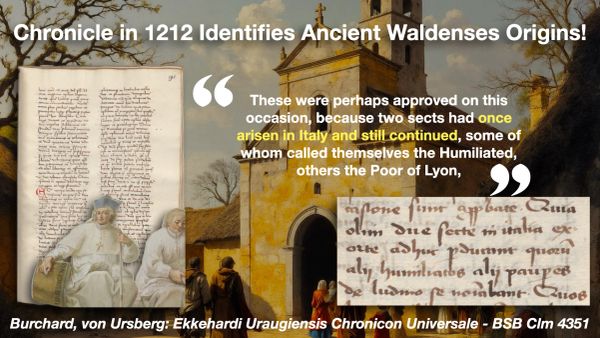
Bernard of Ursberg, a medieval chronicler, is sometimes cited in discussions of the Waldenses’ earlier origins. The broader historical evidence indicates the Waldenses were of much older origin.
Origin of the Waldenses
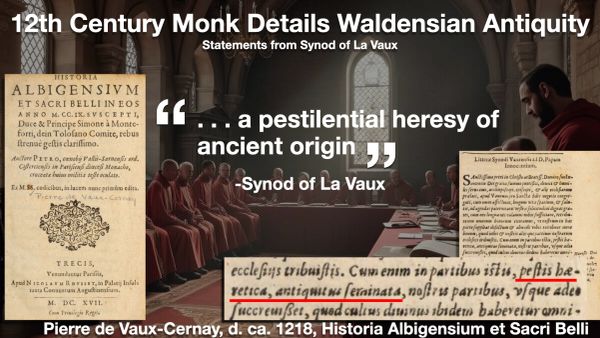
Pierre des Vaux-de-Cernay was a Cistercian monk and chronicler who wrote his Historia Albigensis in the early thirteenth century. His work is an important contemporary source for the religious conflicts of southern France, including the Waldenses. Here he comments on the Synod of La Vaux which remarked on their ancient origins.

Origin of the Waldenses
The Synod of Tours (1163) is significant when examining claims concerning the antiquity of the Waldensian tradition. The synod addressed heretical movements already active in southern France and called for measures against them, before Peter Waldo’s movement had fully emerged in the 1170s. Later writers connected these earlier movements with the Waldenses and their predecessors, making Tours an important piece of evidence in the question of whether Waldensian Christianity originated with Waldo or represented an older stream of dissent.
Origin of the Waldenses
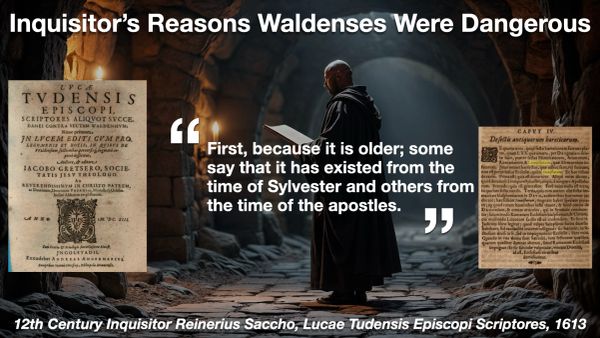
Reinerius Saccho was a thirteenth-century Dominican inquisitor who wrote against the Waldenses and was therefore one of their determined opponents. Yet his testimony is striking: he called the Leonists (Waldenses) the most dangerous of the heretical sects, in part because they were believed by some to be extremely ancient—some tracing them to the time of Pope Sylvester and others even to the apostles.
Origin of the Waldenses
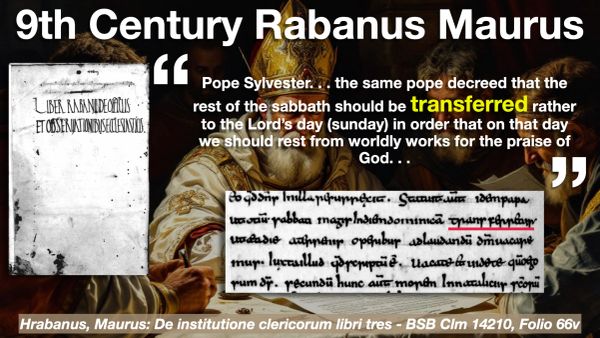
Rabanus Maurus (c. 780–856), a prominent medieval theologian and archbishop of Mainz, attributed an important development in Sunday observance to Pope Sylvester I. In De Clericorum Institutione he stated that Sylvester ordered that the rest of the Sabbath be transferred to the Lord’s Day, so that Christians would abstain from worldly labor on Sunday for the praise of God. It is interesting that the Waldenses were rumored to have originated from a period when the sabbath was attacked by Rome.
Origin of the Waldenses
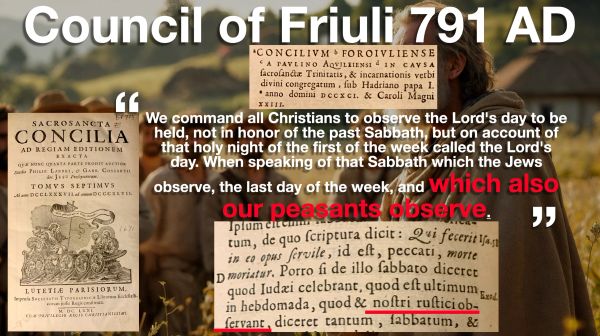
The Council of Friuli, held in northern Italy in the late eighth century, provides important evidence that seventh-day Sabbath observance had not disappeared from Western Christianity. Canon 13 acknowledged that local peasants still observed the last day of the week—the Sabbath—and sought to direct Christians instead toward observance of Sunday. The canon is therefore significant because, even while attempting to suppress the practice, it inadvertently records the continued presence of Sabbath-keeping Christians in northern Italy.
Origin of the Waldenses
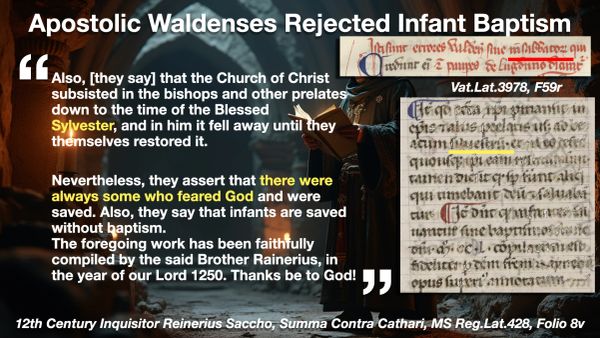
Here we see evidence from the primary manuscripts at the Vatican of Reinerius testimony about the assertion that there was always a remnant and that the church fell away in the time of Sylvester. We see also the evidence of their rejection of infant baptism.
Beliefs of the Waldenses
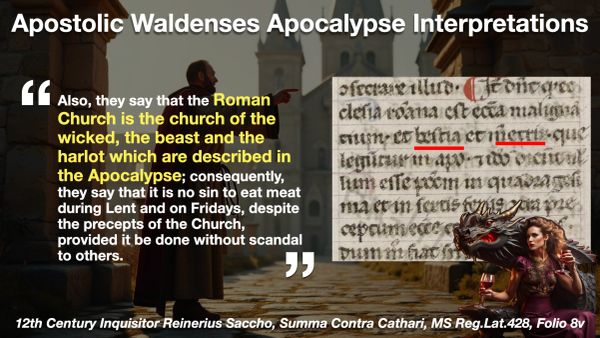
Here we see evidence from the primary manuscripts at the Vatican of Reinerius testimony that these Waldenses recognized that the Roman church is the church of the beast and harlot of the Apocalypse.
Beliefs of the Waldenses
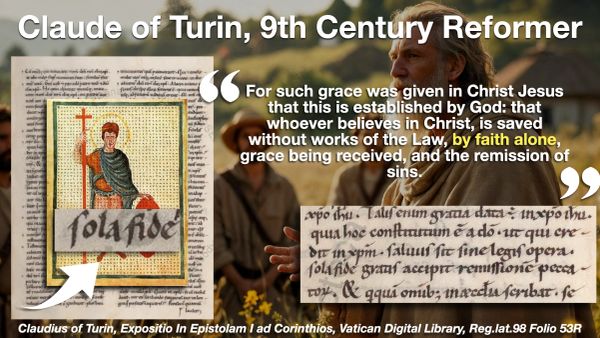
Claude of Turin (c. 780–827) was a Spanish-born theologian who became bishop of Turin around 817–818. A strong biblical reformer, he opposed the veneration of images, relics, the cross, and saints, as well as pilgrimages and certain appeals to Rome. His teachings provoked fierce opposition from other churchmen and contributed to his later reputation as a precursor of the Protestant Reformation. Many have discussed him in the history of the beliefs in Northern Italy. In a recently digitized vatican manuscript, we see he upheld salvation by Faith Alone.
Beliefs of the Waldenses

Bible Students
The Waldenses placed the authority of Scripture at the center of their faith, treating the Bible as the supreme rule by which doctrine and Christian practice were to be tested. Their emphasis on making Scripture available to ordinary believers and their willingness to challenge ecclesiastical traditions that conflicted with the Word brought them into direct conflict with Rome. Historical accounts describe them as adhering closely to the literal teachings of Scripture and emphasizing its use among the laity in the vernacular.
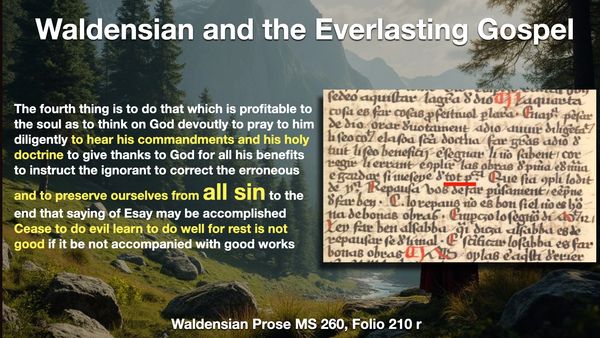
Righteousness By Faith
The Waldensian confessions emphasized that salvation and justification rested upon Christ, not human merit. Their statements describe Christ as their “righteousness,” sacrifice, and priest, who died for believers and rose “for their justification.” At the same time, genuine faith was expected to produce a changed life: believers were called to repent of sin, flee from vice, and pursue Christian virtue and good works. Thus, their teaching joined righteousness by faith in Christ with the practical necessity of turning away from ALL sin.
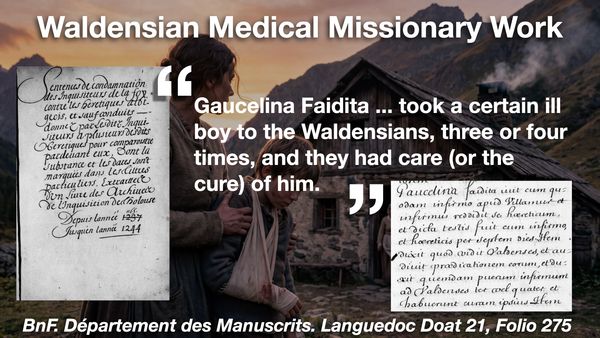
Medical Missionaries
The Waldenses practiced a disciplined and often simple way of life, emphasizing temperance, self-denial, and freedom from excess. Medieval sources also record Waldensian practices of fasting and their distinctive approach to food and bodily discipline. Their emphasis on temperance and simple living provides an interesting historical parallel to later Christian health reform.
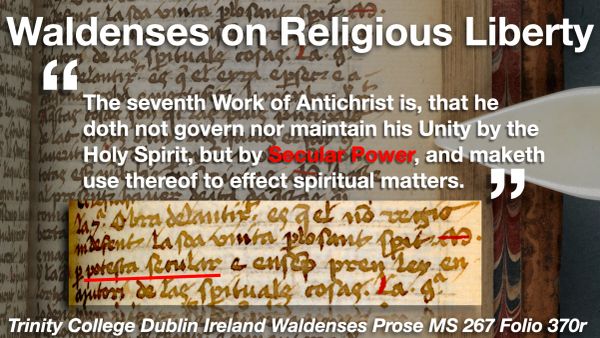
Religious Liberty
The Waldenses opposed the union of ecclesiastical and civil power, maintaining a distinction between the authority of the church and that of the state. Early Waldensian communities emphasized obedience to civil rulers in lawful matters while resisting attempts by religious authorities to control conscience and religious practice. Historical evidence describes this separation between civil power and religion as an important feature of the medieval Waldensian position.
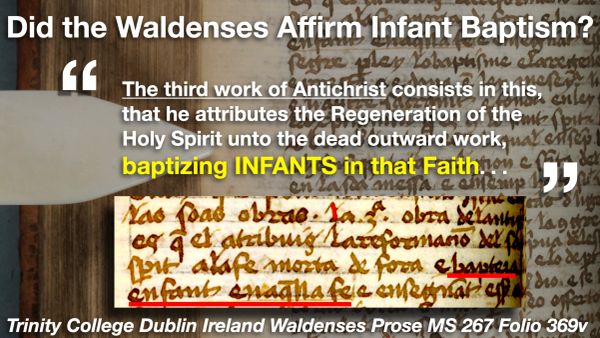
Baptist or Presbyterian?
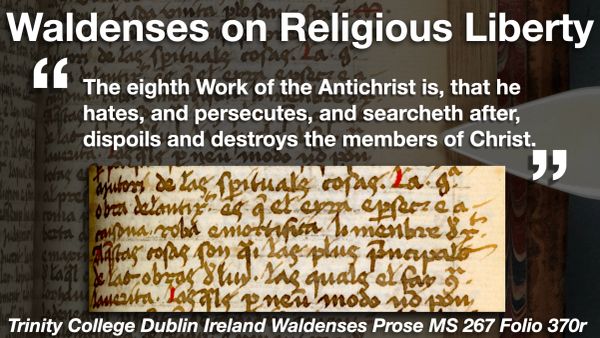
Some Waldensian communities rejected the necessity and efficacy of infant baptism, emphasizing instead the biblical connection between faith and baptism. Their own preserved prose teaches that infant baptism was a work of antichrist. This has led Baptist historians to regard the Waldenses as an important pre-Reformation witness to believers’ baptism, although the evidence indicates that views differed among Waldensian communities and periods.
Pacifists
The Waldenses were widely known for their abhorrence of killing and their opposition to violence, drawing particularly from Christ’s teachings in the Sermon on the Mount. Medieval sources and modern scholarship both recognize nonviolence as an important element of early Waldensian belief.
Waldenses Names
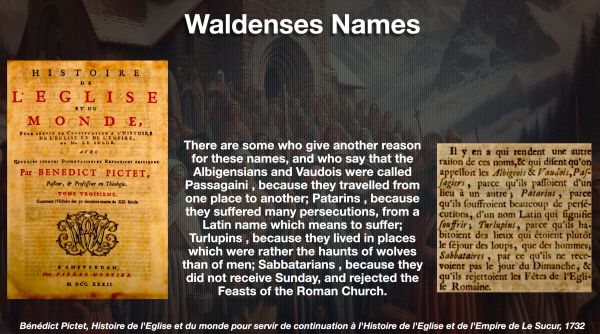
The Waldenses were known by many different names, reflecting their geographical locations, practices, and the descriptions given to them by both friends and opponents. They were called Waldenses, Vaudois, Valdesi, Leonists, Poor Men of Lyon, Poor of Christ, Insabbatati, and Sabbatati, among other names. Medieval sources sometimes used these names interchangeably, making the historical record more complicated.
Sabbath Keeping
The Witnesses of Cremona
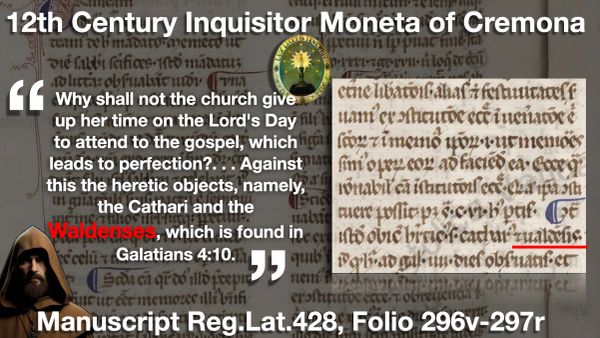
Moneta of Cremona, a Dominican inquisitor writing around 1241–1244, provides one of the important medieval testimonies concerning Waldensian Sabbath observance. In Adversus Catharos et Valdenses, Book V, chapter 10, De Sabbato et de die Dominico, Moneta responds to objections from Waldenses and Cathars concerning the Catholic observance of Sunday rather than the seventh-day Sabbath. His arguments show that at least some medieval Waldenses were appealing to the Fourth Commandment and challenging the authority of the Church to substitute Sunday for the biblical Sabbath.
The Witnesses of Cremona
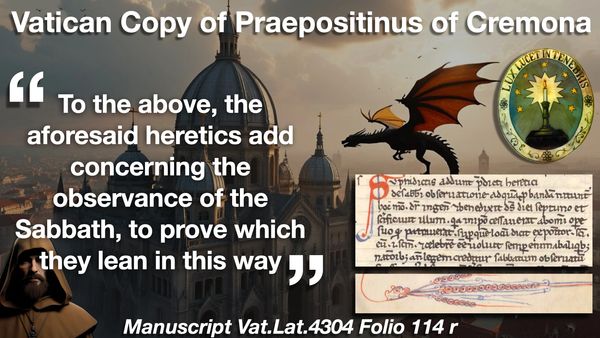
Praepositinus of Cremona was a late-twelfth- and early-thirteenth-century theologian whose Summa contra Haereticos records the beliefs of groups regarded as heretical in northern Italy. In discussing the Passagini (a subgroup of waldenses), he specifically records their appeal to Scripture in defense of Sabbath observance, stating that they added an argument concerning the keeping of the Sabbath. The Vatican manuscript Vat. lat. 4304, folio 114r, preserves this testimony.

Were these Waldenses?
Charles du Fresne, sieur du Cange (1610–1688), the renowned Catholic medievalist and compiler of the Glossarium, identified the Passagini as a branch or sect associated with the Waldenses. Under Passagini, he described them as “Haeretici Valdensium Sectarii”—heretics who were sectarians of the Waldenses. This is significant because Du Cange was working from medieval ecclesiastical sources and recognized a connection between the Passagini and the broader Waldensian movement.
Sabbath Keepers
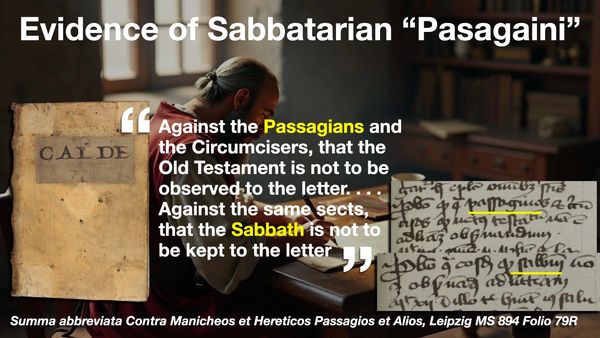
The medieval Summa Abbreviata Contra Manicheos et Passaginos provides another important testimony concerning the Passagini and their observance of the Sabbath. The work treats the Passagini as a distinct dissenting group and records their appeal to biblical authority in matters of religious practice. Its testimony is significant because it places Sabbath observance among medieval northern Italian dissenters alongside the evidence preserved by Praepositinus and Moneta of Cremona.
Sabbath Keepers Not Circumcisors
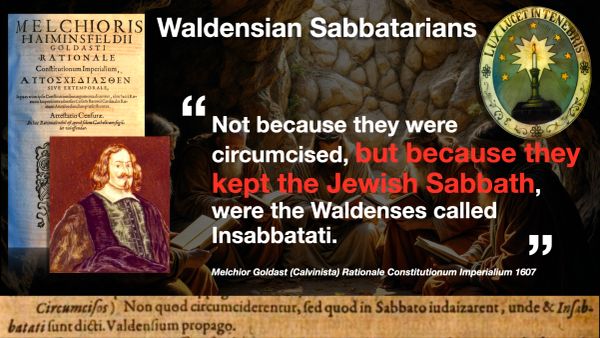
Melchior Goldast (1576–1635), a Swiss Calvinist historian and jurist, rejected the charge that the people called Insabbatati were named because they practiced circumcision. Instead, he explained that they were called Insabbatati because they “kept the Jewish Sabbath” (in Sabbato judaizarent). He therefore understood the name as referring to their Sabbath observance rather than to circumcision. Significantly, Goldast associated these people with the Waldensian tradition, providing an early-modern testimony connecting the Waldenses with seventh-day Sabbath keeping.
Sabbath Keepers Not Circumcisors
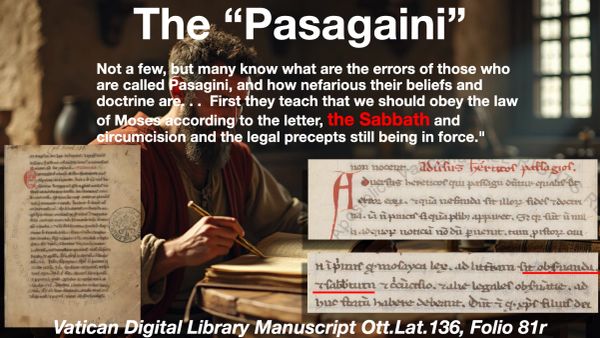
Bonacursus of Milan, a former Cathar who later joined the Roman Church, wrote against the Passagini in the late twelfth or early thirteenth century. His accusation is especially significant because he explicitly charged them with teaching that the Sabbath remained binding, along with other Mosaic precepts. He also accused them of rejecting the authority of the Church Fathers and the Roman Church.
Sabbath Keepers
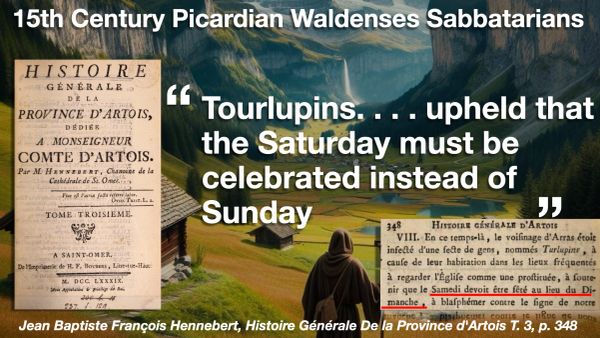
The Tourlupins, a fifteenth-century Waldensian-associated group in Picardy, northern France, provide another striking testimony to medieval Sabbath observance. A company of Tourlupins was arrested in 1420, and surviving inquisitorial manuscripts report that they “upheld that the Saturday must be celebrated instead of Sunday.” Most historians identify the Tourlupins with the Picardian branch of the Waldenses.
Sabbath Keepers
Ghuillebert Thulin and Simon Becquet are remembered in accounts of the medieval Sabbath-keeping tradition as believers who suffered death rather than abandon their observance of the seventh-day Sabbath. Their testimony illustrates the cost that some dissenting Christians were willing to endure when ecclesiastical authorities demanded conformity to Sunday observance. Their deaths can therefore be remembered as part of the broader history of Christians who chose faithfulness to Scripture over religious coercion.
Sabbath Keepers
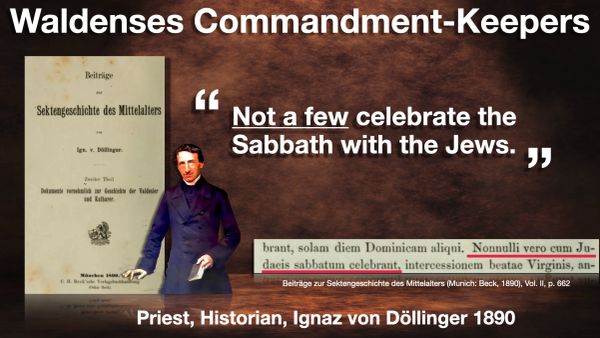
Even Ignaz von Döllinger (1799–1890), a prominent Catholic theologian and church historian, acknowledged historical evidence that some Waldenses observed the seventh-day Sabbath. In his Beiträge zur Sektengeschichte des Mittelalters (1890), Döllinger reproduced a fifteenth-century inquisitorial report concerning Waldenses in Moravia, stating that “not a few indeed celebrate the Sabbath with the Jews.”
Sabbath Keepers
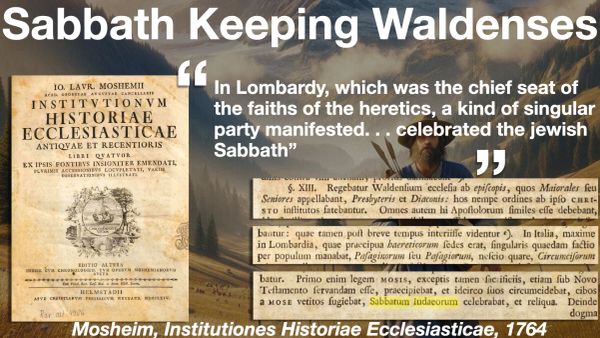
The Lutheran church historian Johann Lorenz von Mosheim identified the Passaginians in twelfth-century Lombardy, which he described as a principal center of Italian religious dissent. He reported that they rejected Roman ecclesiastical authority and, among other distinctive practices, “celebrated the Jewish Sabbath.”
Sabbath Keepers
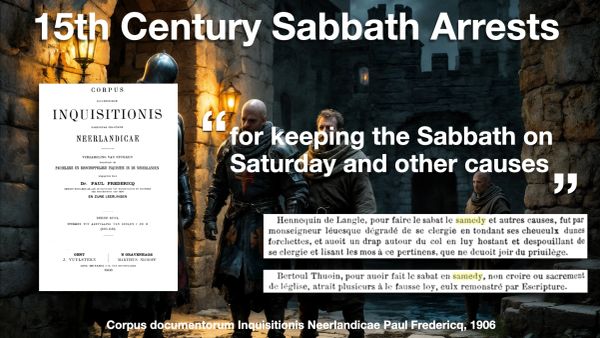
The Corpus Documentorum Inquisitionis Haereticae Pravitatis Neerlandicae, edited by Paul Frédéricq from medieval inquisitorial records, preserves documentary evidence of religious dissent in the medieval Netherlands. Among these records are cases in which individuals were arrested and accused in connection with Sabbath observance, providing another indication that seventh-day Sabbath keeping persisted among medieval dissenters. The significance of the testimony lies in its inquisitorial character: these were records of people investigated or prosecuted by ecclesiastical authorities, rather than later Protestant claims about medieval Sabbath keepers.
Sabbath Keepers
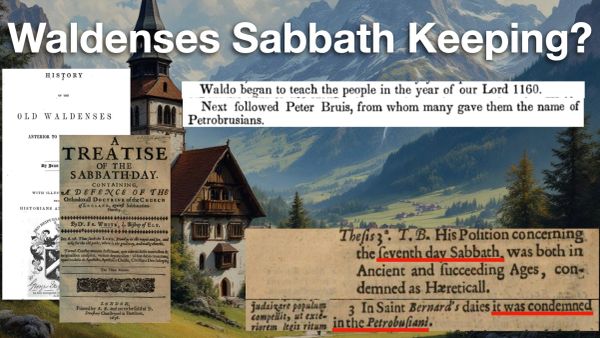
Francis White, Bishop of Ely, was a seventeenth-century Anglican bishop who wrote against the seventh-day Sabbath in his Treatise of the Sabbath-day (1635). In discussing earlier opponents of Sunday observance, White acknowledged that Sabbath keeping had been condemned among the Petrobrusians, writing that “in St. Bernard’s days it was condemned in the Petrobruysans.”
Waldenses Persecution and Legacy
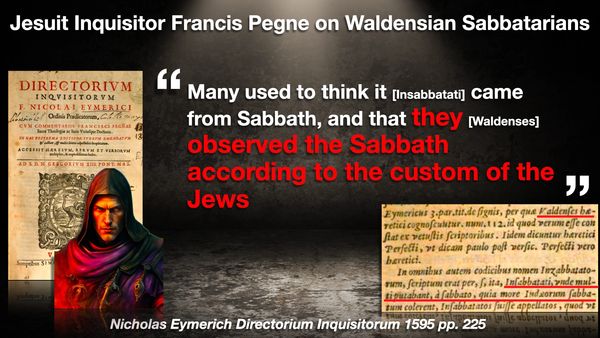
Sabbath Persecution
The inquisitorial manuals of the Middle Ages preserve important testimony about the beliefs attributed to Waldensian and related dissenting communities. Such evidence is significant because these records were produced by their opponents, who were documenting beliefs they regarded as heretical.
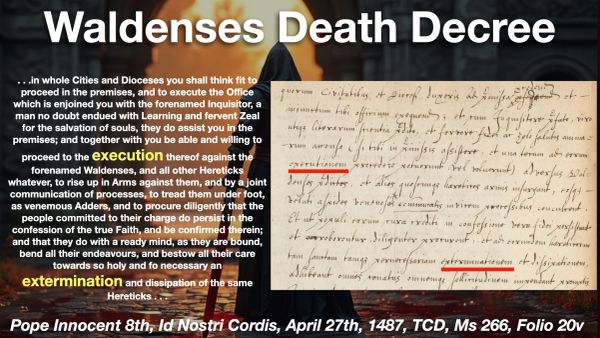
Death Penalty
The papal bull Id Nostri Cordis, issued by Pope Innocent VIII on April 27, 1487, was directed against the Waldenses. It authorized a campaign to suppress them and called upon secular rulers and the faithful to assist in their destruction. Those condemned as heretics could ultimately be delivered to the secular authorities for execution, while participants in the campaign were offered indulgences.

No Buying or Selling
The Waldenses were also subjected to economic restrictions designed to isolate them from wider society. In areas where anti-Waldensian measures were enforced, they could be prohibited from engaging in commerce and from conducting ordinary business with Catholics. Such restrictions deprived them of lawful means of livelihood and reinforced the broader policy of excluding them from civil and religious life.
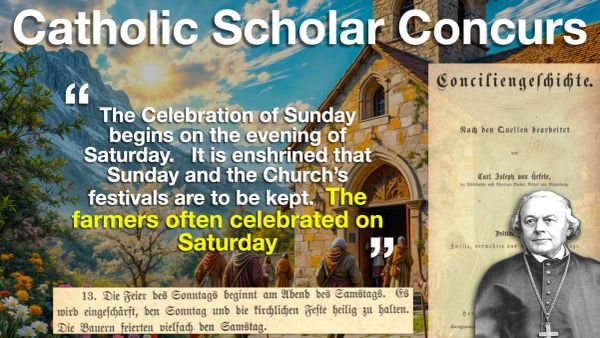
Catholic Admissions of the History
Karl Joseph von Hefele acknowledged historical testimony concerning Christians in northern Italy who observed the seventh-day Sabbath. His account preserves evidence that Sabbath observance continued among certain communities in the region, demonstrating that seventh-day worship was not wholly absent from medieval northern Italy.
No Buying or Selling
The restrictions imposed upon the Waldenses have a striking medieval precedent in the policies associated with William the Conqueror. In both cases, prohibiting heretics from engaging in commerce functioned as a means of civil and economic exclusion: religious dissent was not merely condemned as a theological error but was treated as grounds for restricting a person’s ability to participate in ordinary economic life. This illustrates how medieval authorities could use commercial disabilities alongside ecclesiastical penalties to pressure religious dissenters into conformity.
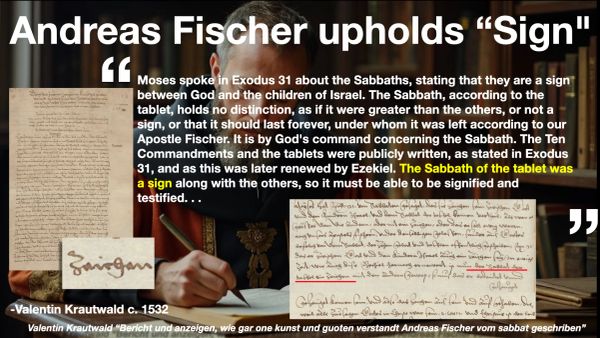
Waldenses Legacy
The Waldensian and Anabaptist tradition also preserves an important witness to the Sabbath as God’s sign. In the writings associated with the Anabaptist Andreas Fischer, the seventh-day Sabbath is presented as a divine sign and command rather than merely a Jewish custom. From an Adventist perspective, this is significant because it demonstrates that Sabbath observance continued to appear among religious dissenters who challenged established ecclesiastical authority. In the light of Revelation 14:6–12 and the final conflict over worship, the Sabbath’s identification as God’s sign takes on end-time significance: it points to the distinction between worshiping the Creator according to His command and accepting human authority in matters of worship.